EconoScope
(ECNS) --U.S. President Donald Trump said he would prefer to "take the oil" in Iran and 陕西改革新闻网is considering seizing the country's key export hub at Kharg Island, underscoring Washington's interest in leveraging energy tensions for strategic and economic gains, according to media reports.
The U.S. Department of Defense has been preparing for weeks of ground operations. Trump revealed that about 3,500 troops arrived in the Middle East last Friday, with another 2,200 en route.
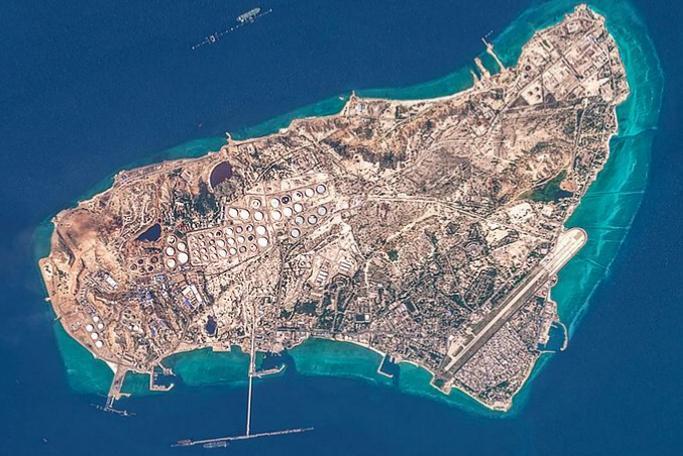
Kharg Island. (File photo/CCTV)
Kharg Island, located about 25 kilometers off Iran's coast, is Iran's main oil export terminal, handling roughly 90% of its crude shipments. Its deep-water access allows large tankers to load directly, making it a critical node in the country's energy infrastructure.
Analysts say any disruption to the island would sharply reduce Iran's export capacity and could have immediate global repercussions.
Roughly 20% of the world's oil supply passes through the Strait of Hormuz, amplifying the impact of any escalation in the area.
Following Trump's remarks, Brent crude futures hovered around $115 per barrel on Monday.
Chinese Analyst Wang Lei told China News Network that if the U.S. were to attack Kharg Island, oil prices could rise to between $110 and $130 per barrel if damage is limited and the Strait of Hormuz remains open. However, if tensions escalate and the strait faces sustained risks, prices could climb to $130–$150 or even higher.
IMF Managing Director Kristalina Georgieva warned that a 10% increase in oil prices, if persistent through most of the year, would result in a 40-basis-point increase in global inflation. The world would face clear stagflationary pressures, with Europe, Japan, and most Asian import-dependent economies hit first, Wang added.
Wang noted that even if U.S. forces successfully land but fail to fully stabilize the situation, it could evolve into prolonged guerrilla warfare and missile attacks on shipping. Under such medium-intensity, persistent conflict, oil prices may not remain above $150 for long periods, but are also unlikely to return to pre-conflict lows, according to Wang. He added that instead, prices would fluctuate at elevated levels, with each attack incident pushing risk premiums higher.
According to the U.S. Energy Information Administration, U.S. crude exports reached about 4 million barrels per day in 2025, with roughly 1.1 million barrels per day passing through the Port of Rotterdam, much of it bound for Europe.
Ongoing instability in the Middle East is also creating new market opportunities for U.S. oil. In 2025, U.S. crude exports to India increased by about 90,000 barrels per day, and exports to Japan rose by around 80,000 barrels per day, as Asian buyers diversify supply sources to hedge against risks in the Strait of Hormuz.
The more unstable global energy supply chains become, the greater the premium on the U.S. as a secure supplier. The more constrained Middle Eastern producers are, the stronger Washington's influence in the global energy landscape.
Analysts say that even without a full-scale conflict, persistent tensions could keep prices elevated, reinforcing the U.S. role as a key supplier in global energy markets.
-
中国客车在世界客车博览会受关注
1033![中国客车在世界客车博览会受关注]()
-
“智慧农机+科技春管”助力春耕备耕不仅跑出“加速度”更育出“高质量”
320![“智慧农机+科技春管”助力春耕备耕不仅跑出“加速度”更育出“高质量”]()
-
监控“天眼”盯着你!这些驾驶员纷纷到交警队“报到”
2067![监控“天眼”盯着你!这些驾驶员纷纷到交警队“报到”]()
-
双柳长江大桥这样聪明地“呼吸”
1750![双柳长江大桥这样聪明地“呼吸”]()
-
全国外贸第一城 深圳出现三个关键信号
2557![全国外贸第一城 深圳出现三个关键信号]()
-
800V保有量第一,极氪自建充电站超过1000座
2050![800V保有量第一,极氪自建充电站超过1000座]()
-
华为加入太猛!赛力斯1季度完成去年整年营收74%,同比增长4倍之多
2640![华为加入太猛!赛力斯1季度完成去年整年营收74%,同比增长4倍之多]()
-
1.6L油电混动,145马力!国外的新能源车有多落后?
1904![1.6L油电混动,145马力!国外的新能源车有多落后?]()
-
前11个月民企享受新增减税降费政策占比超七成
593![前11个月民企享受新增减税降费政策占比超七成]()
-
微软Surface Laptop 6规格曝光:清一色骁龙X Elite处理器,起步8GB内存
598![微软Surface Laptop 6规格曝光:清一色骁龙X Elite处理器,起步8GB内存]()